


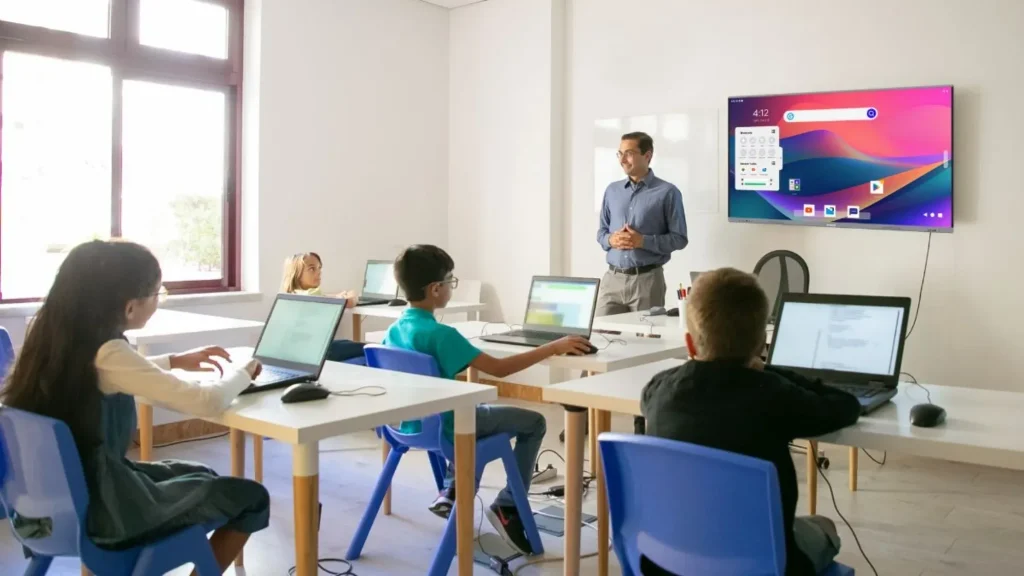
Smart classroom learning is no longer a “luxury feature” for only big private schools—it’s becoming a practical, everyday way to teach better, learn faster, and keep students genuinely interested. In a world where kids grow up using smartphones and watching videos to learn everything from cooking to coding, traditional chalk-and-talk methods often feel slow and disconnected.
The good news is that smart classrooms don’t replace teachers. They support teachers.
They help explain tough concepts visually, reduce time wasted on repetition, and create a learning environment where students feel involved instead of forced to sit quietly. Whether it’s a primary classroom learning basic math or a senior class understanding science experiments, smart tools can make the difference between “I memorized it” and “I understood it.”
This article breaks down what smart classroom learning really means, how it works in real schools, and how teachers and parents can make it successful without turning education into a screen-only experience.
What smart classroom learning really means (in simple words)
When people hear “smart classroom,” they often imagine a classroom filled with expensive gadgets. But smart classroom learning is not about showing off technology—it’s about using the right tools to make teaching more effective.
It usually includes digital content, interactive screens, audio-visual explanations, and learning software that helps teachers present topics in a clearer way. Instead of only writing on a blackboard, teachers can show diagrams, animations, videos, and quizzes to make lessons more engaging.
Think of it like this: a smart classroom is the same classroom, with the same teacher, but with better support materials.
And when students learn with both visuals and explanations, the brain retains information longer. That’s why this approach has become popular in schools across India and globally.
The classroom problem we all know (and smart learning solves)
Let’s be honest—many students struggle not because they’re weak, but because the method doesn’t match their learning style.
Some students learn by reading. Some learn by listening. Some need to see an example. Some need to try it themselves.
In a traditional setup, the teacher explains once or twice, and then moves ahead. Students who understood it go forward. Students who didn’t often stay silent because they feel embarrassed.
Smart classroom learning helps here because it gives students multiple ways to understand the same concept.
A video can simplify a chapter. An animation can explain what words can’t. A quiz can help students test their understanding without fear.
When learning becomes interactive, students participate more. And participation is where real learning begins.
Smart classroom learning: how it looks in a real school day
A smart classroom doesn’t mean every minute is digital. It usually blends teaching with technology.
For example, a teacher may start the lesson by asking questions, then show a short visual explanation, then do a quick activity, and finally revise the key points.
A science teacher explaining the solar system can use a 3D animation to show movement of planets. A math teacher teaching fractions can show real-life examples like pizza slices and measurement visuals.
In language classes, smart tools can help students learn pronunciation and grammar using audio clips and interactive exercises.
This makes learning feel alive, not like a one-way lecture.
And the best part? Teachers don’t need to be “tech experts.” Most tools are designed to be easy to use.
Why students respond better to smart learning methods
Students today are used to learning quickly. They watch short videos, learn step-by-step, and replay things they didn’t understand.
Smart classroom learning matches that natural style.
Instead of only reading a paragraph about evaporation, students can watch a short animation that shows water turning into vapor. Instead of memorizing historical dates, they can explore timelines and visual maps.
This doesn’t reduce the importance of textbooks. It simply makes textbooks easier to understand.
Students also feel more confident when they understand concepts clearly. Confidence improves performance. And performance improves interest.
This creates a positive cycle: better understanding leads to better marks, and better marks lead to better motivation.
Teachers are the heroes of smart classrooms, not the screens
One big misunderstanding is that technology will “replace teachers.”
That is not the goal.
A smart classroom works best when teachers lead the learning and technology supports them. Teachers decide what to teach, how to teach, and how to guide students. Digital tools only make the explanation stronger.
In fact, smart learning can reduce teacher stress. Teachers don’t have to draw complex diagrams repeatedly. They don’t have to waste time searching for examples. They can focus on guiding students, clearing doubts, and improving learning outcomes.
Many teachers say that once they get comfortable with smart tools, their classroom becomes more organized and interactive.
Teaching becomes smoother, and students become more responsive.
Smart classroom learning improves attention (especially for younger kids)
Younger students have shorter attention spans. They learn better when lessons are broken into small, interesting segments.
Smart classrooms help teachers do that naturally.
A lesson can include a short explanation, a visual activity, and a quick practice round. This keeps students engaged without making them feel bored.
Even simple tools like interactive games, digital flashcards, and audio stories can make a huge difference.
When kids enjoy learning, they don’t need to be forced to study.
And when learning becomes enjoyable early, students carry that positive attitude into higher classes too.
A simple story: how one shy student started participating
A teacher once shared an experience from a middle school class.
There was a student who never raised his hand. He was quiet, always sitting at the back. The teacher assumed he wasn’t interested.
One day, the teacher used an interactive quiz on the smart screen. Students could answer without speaking loudly. The shy student answered correctly multiple times.
That was the first moment the teacher realized he understood the topic—he just didn’t feel confident speaking in front of others.
Later, the teacher encouraged him gently, and he slowly started participating.
That’s the real power of smart classroom learning—it creates different ways for students to express understanding.
Not every student is a “front-bencher speaker.” Some students need a different path to confidence.
Smart classroom learning and better exam preparation
Smart learning doesn’t just make lessons fun—it also helps students prepare better for exams.
Many smart classroom tools include practice questions, chapter-wise tests, and instant feedback. Students can quickly understand what they got wrong and why.
This reduces the habit of “blind memorization.”
Instead, students start learning through understanding and practice. That’s the best way to score well and retain knowledge for the future.
Teachers also benefit because they can quickly assess which topics students are struggling with. They can revise those topics again without wasting time on chapters students already know well.
This makes exam preparation more targeted and less stressful.
How smart classrooms support inclusive learning
Not every student learns at the same pace.
Some students need more time. Some students need extra practice. Some students may have learning difficulties that require additional support.
Smart classroom learning can help by offering multiple formats of the same lesson. A student can watch an explanation again. A student can practice more questions. A student can learn using visuals instead of only text.
This creates a more inclusive environment where students don’t feel left behind.
It also reduces the gap between fast learners and slow learners.
When the entire class gets equal learning support, the overall performance improves.
Smart classroom learning: the tools that usually make it work
Most smart classrooms use a mix of tools that are easy to manage.
Interactive displays or projectors help teachers show content clearly. Digital lesson modules help explain concepts with visuals. Learning apps support practice and revision.
Some schools use tablets or student devices, while others use only one central screen for teaching.
The goal is not to overload the classroom with devices. The goal is to use technology where it genuinely improves learning.
A well-planned smart classroom feels smooth, not distracting.
When technology becomes too much, it can reduce focus. That’s why balance matters.
The biggest mistake schools make with smart learning
The biggest mistake is thinking that buying equipment automatically improves education.
Smart classroom learning works only when teachers are trained and supported.
If a school installs screens but doesn’t guide teachers on how to use them, the tools may remain unused. Or they may be used only for showing random videos without learning structure.
A smart classroom should have a clear plan. Teachers should know what content is available, how to use it, and when to use it.
Also, schools should ensure that smart learning is aligned with the curriculum. It should support the syllabus, not distract from it.
When planning is strong, results improve naturally.
Smart classroom learning and parent trust
Parents want one thing: real progress.
When parents hear “smart classroom,” some feel excited. Others worry that their child will spend too much time on screens.
Both reactions are valid.
The key is transparency.
Schools should explain how smart classroom learning is used. Parents should know that it is not “cartoon time.” It is structured learning with visuals, practice, and teacher guidance.
When parents see better understanding, improved marks, and more interest in studies, trust increases.
Many parents also notice that their children start explaining concepts at home with confidence.
That’s a strong sign that learning is happening properly.
How smart learning helps in rural and semi-urban schools too
Smart classrooms are not limited to big cities.
In many rural and semi-urban areas, smart classroom learning is helping bridge the gap between limited resources and quality education.
Some schools may not have enough subject-specialist teachers. Smart content helps teachers deliver better explanations even when resources are limited.
Students in smaller towns also deserve modern learning tools. When they get access to visual learning, their confidence grows and their understanding improves.
It creates a more equal education system where students are not disadvantaged due to location.
Smart learning can become a strong support system for schools that want better results with limited staff.
Smart classroom learning and skill-based education
Modern education is not only about marks. It’s also about skills.
Students need communication skills, problem-solving ability, creativity, and digital confidence. Smart learning supports these skills naturally.
When students use interactive tools, they learn how to think, respond, and solve problems. When they watch concept-based videos, they learn how to understand, not just memorize.
Some smart learning programs also include coding basics, logical reasoning exercises, and real-world examples.
This prepares students for future careers, not just exams.
Education becomes more meaningful when it connects with real life.
How to make smart learning effective without overusing screens
Technology should be used like a tool, not like a replacement for everything.
Smart classroom learning works best when there is a balance between digital teaching and traditional learning activities.
Students still need to write. They still need to read textbooks. They still need to practice questions on paper. They still need to interact with teachers and classmates.
The smart part is the support content that makes understanding easier.
A healthy classroom includes discussion, writing practice, revision, and digital explanation in the right ratio.
When teachers manage this balance, students stay focused and learning becomes deeper.
The future of education is blended, not fully digital
Education is evolving fast.
But the future is not about removing teachers or removing books. It’s about blending methods.
Smart classroom learning is one of the strongest examples of blended education—where teaching remains human, but learning becomes richer through technology.
Schools that use smart tools wisely will build stronger student outcomes, better engagement, and improved confidence.
Teachers who adapt to smart teaching methods will find their classrooms more interactive and less stressful.
And students who learn in smart classrooms will be more prepared for modern life, where learning never stops.
That’s why Smart classroom learning is not just a trend—it’s becoming a practical foundation for better education.
Read also:
e shiksha course bihar
kerala blasters vs mumbai city fc timeline
bengaluru fc vs northeast united fc standings
e shiksha bihar